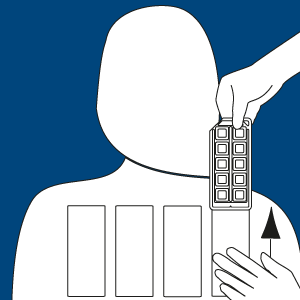
A 1. Put the IQ Ultra® unit on a table,for use the IQ Ultra’s® application plate (diagram A7). Take a firm grip on either the right or the left perforated corner of the plastic cover. If you use the IQ Ultra’s application plate, perform steps 2 & 3 and put the units in the plate by sliding them into the compartments. The end of the unit without the perforated corners should be inserted first. (See diagram A7) 2. Pull off the perforated corner of the plastic cover by bending it upwards over the edge of the cover so that the perforation will brake. 3. Pull back the tape gently until all chambers are available for filling. The tape should not be detached from the cover. 4. Apply the test preparation into the upper right chamber. Proceed with the other chambers until all are filled and the test unit is ready for application onto the patients back. Remember that when applied to the back, the order of the haptens will be left to right reversed, that is, the upper right chamber will be no.1 at left. 5. Grip the end of the tape and the plastic cover (diagram A5). Press the tape to the back from below upwards. Remove the plastic cover (diagram A6). Instruct the patient to bend gently forward when you apply the test units. Press the tape with the palm of your hand for about 5 seconds (diagram A6). The pressure and heat will enhance adhesion. IQ Ultra’s® has the unique feature in that the rim of each chamber has an adhesive layer providing optimal adhesion of the chamber onto the skin. Therefore, no additional reinforcement of the tape unit is needed and leakage from the chamber is eliminated. The patient may perform normal work as well as light exercise during the test application. B. When applying liquid haptens, apply a drop of the test solution to the filter paper in the chamber (about 25 μl). The amount should be just enough to properly moisten the filter paper. Do not prepare liquid solutions in advance for storage. C. When applying the test patches on the patient, use if possible the upper part of the patients back, and avoid to apply patches to the midline and the scapula. If several test series are applied, 2 horizontal rows of 4-5 units per row can be applied across the back. In some cases other areas of the body like the upper part of the arms may be used. If the patients skin is oily you can clean it gently with some ethanol. |
|
D. Mark to the left of the tape the first and the 5th chamber or the four corners of each unit with the special Chemotechnique Skin Marker. Make a record on a record form of the numbers and names of each hapten starting with no.1 of the left upper patch and going down and continue then to the right until all patches are recorded. For record forms, visit our website www.chemotechnique.se where ready forms are available under the section ”record forms”. E. Give the patient a test information sheet. Provide the patient a copy of “Initial Patient Instruction Sheet”, covering procedural information, do’s and don’ts, care and cautions (available on our website). F. The patches should be removed after 48 hours. When removing the patches it is very important to detach the units in a rapid diagonal direction to minimize patient discomfort (diagram A8). Visual imprints on the skin from each chamber + a slight erythema from the frames should be visible as a sign of good occlusion. The material of the test units are recyclable and unlike aluminum containing material environmentally safe. Reading of the test is performed at day 3 or 4 after test application. At day 3, a weak erythema from the frames might be present in patients with sensitive skin. Some clinics prefer to add an initial reading when the tape units are removed. If this is made, allow initial skin irritation from the backing tape and the foam frame tape to subside, as well as reduction of the visual imprint on the skin due to the high skin occlusion of the chambers. Use the IQ Ultra® Reading Plate to facilitate the reading. In many instances, a second reading a week after the application is of value. The back should not be rubbed by e.g. a brassiere or be scratched in the case of positive reactions. The patient should not take any cortisone medication during the test and avoid exposure of the back to the sun. For the interpretation of the test result the following scheme can be used:
- Negative reaction.
? Doubtful reaction.
+ Weak reaction (non-vesicular).
++ Strong reaction (oedematous or vesicular).
+++ Extreme reaction (ulcerative or bullous).
IR Irritant reaction.
NT Not tested. |